Pages

Showing posts with label phone information. Show all posts

Monday, 6 August 2012

How to Recover Deleted Contacts Numbers from your SIM Card ?

One of my friend unfortunately deleted my all Contacts phone numbers in my SIM card of My phone.There were some important contacts on his SIM . He presented this problem in front of me I began to tried all.Finally I found this Easy Way to Restore those from his SIM card.
Looking for a trick to regain your lost Phone contacts in your Mobile phone SIM card ?. Here is a wonderful and easy trick to recover your unfortunately deleted or lost SIM Contacts .This procedures requires a Computer and a SIM Reader .To do so see the steps mentioned below
Requirements: Your SIM card to be recovered, A GSM Reader (SIM Card reader), A computer
*. Put your SIM card to your SIM card Reader
*. Install the Driver software for this Device.
*. After installing open the software ( connect the device through USB port )_ (see Screen short)
*. Click the 3rd button ( as shown in above screen short)
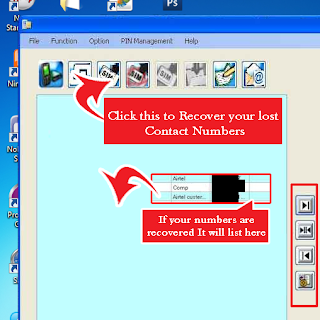
*. Clicking the image there list a list of contacts
*. You can either save or copy,,,or do any options in the software

Thursday, 19 July 2012

Skyhook promises constant mobile location without battery drain


The company hopes better battery life will spur location-based innovation


Skyhook introduced on Wednesday a new version of its location engine for mobile apps that it said will allow smartphones to determine a user's location once a minute throughout the day without draining the battery
Skyhook's SDK interprets information about the Wi-Fi access points and cellular towers a smartphone has contacted and combines it with the phone's GPS interface to plot the device's current location. Skyhook has developed its own database of Wi-Fi and cellular locations.
Some location services query a server each time they update the user's location. Skyhook downloads compressed information about Wi-Fi access points and cell towers in a five- to ten-mile radius the first time a smartphone registers a particular location. As long as the user remains in that radius, the device can determine location without calling a server. Fewer server calls means longer battery life.
The SDK version launched Wednesday also reduces power use by optimizing how the software interacts with the hardware, including how the directory of Wi-Fi access points and cellular towers is stored, said founder and CEO Ted Morgan. Morgan was coy on the details, but said Skyhook was able to apply what it had learned about hardware through recent work with Sony to enable constant location services on its gaming consoles.
Skyhook hopes its battery-life achievement "will open up a whole new class of location apps," Morgan said in an email.
Developers have been reluctant to build apps that rely on constant location information because of the battery-life problem, he said.
Yet apps have begun to emerge that use location in innovative ways. Social apps can use up-to-the-minute location data to inform users when people they know or might like to meet are nearby. They might also notify the user of a discount at a nearby restaurant. Or, like the iOS Reminders app, they might generate notifications based on the user's location.
The latest SDK from Skyhook comes with one other novel feature: Constant location on a plane. Users who are connected to Wi-Fi on an airplane will now be able to track their own location rather than relying on the pilot. Skyhook had to tap different directories than those that work on land to be able to determine where a plane is, Morgan said.
Android is currently the only major operating system to make available to third-party developers the interfaces the SDK needs to work optimally, according to Morgan.

Open Mobile Alliance proposes standard 2D barcode handling system for mobile phones


OMA hopes the standard will will direct mobile phone users to websites more easily and enable interoperability across the 2D barcode market


The Open Mobile Alliance (OMA) has developed a standard for handling 2D barcodes that it hopes will direct mobile phone users to websites more easily. By standardizing the specification for encoding, decoding, and resolution of 2D barcodes, OMA wants to stimulate the usage of the codes, it said.
Camera phone users can snap a picture of a two-dimensional barcode to access additional information on the Web about products promoted by retailers and advertisers. Using the 2D code saves the user opening a browser and typing in a URL or search terms to know more about a product. However, not all such barcodes store information in the same way, nor can they all be read using the same software today.
[ Get the best apps for your mobile device: InfoWorld picks the best iPad office apps, the best iPad specialty business apps, the best Android office apps, and the best Android specialty apps. | Keep up on key mobile developments and insights with the Mobile Edge blog andMobilize newsletter. ]
Consumer usage of two-dimensional bar codes in Japan grew exponentially once the three primary mobile operators there agreed on a common specification to read 2D barcodes, according to OMA. The QR-code was developed by the Japanese Denso Wave software company, and most Japanese phones now come with a built-in QR-reader. While the use of 2D bar codes is quite popular in Japan, adoption of the technology has been relatively slow in the United States, said OMA.
In June 2009, a survey of 800 Japanese people aged 10 to 49 conducted by NetAsia Research found that 76 percent of them had used a QR-code at least once, and the QR code users scanned an average of about five a month.
But two years later, a study by comScore found that only 6.2 percent of U.S. mobile phone users had scanned a 2D barcode in June 2011. In the United Kingdom, France, Italy, Spain, and Germany, 4.6 percent of all mobile phone users and 9.8 percent of smartphone owners had scanned a QR or barcode during the month, comScore found.
With its new standard, OMA wants to enable interoperability across the 2D barcode market, which is fragmented by non-standard formats. The current model is not scalable for the wide variety of retailers, advertisers, handset makers, and mobile operators that want to deploy mobile codes to promote their products and services, it said, adding that standardization can increase usage of 2D barcodes and simplify users' interactions with product information.
The standard comprises two different models. The first model is called a Direct Code, a code that is resolved on the handset using a pre-loaded or downloaded application. The code can invoke functions such as launching a browser, initiating a phone call, sending a text message, or storing contact information in the phone's address book. A network connection is not necessary for this format